50+ countries
Global use, local impact

47 years in business
Originated in 1979

50+ employees
Europe, USA and Asia

2000+ customers
More than 20.000 users
Integration of FMEA and Gage Management in IATF16949
Introduction
Suppliers in automotive need to comply with IATF16949. Related to the core tools this means they need to apply FMEA, perform MSA studies, and apply real time SPC.
Ideally, the three core tools are an integrated system. When referencing a gage in your FMEA, that gage should be calibrated and should have a proper MSA study performed. The control plan identifies what should be measured. Anything that should be measured performed with a gage which is calibrated and has a proper MSA study.
Integration between FMEA and SPC and between MSA and SPC are fairly straightforward. Integration between FMEA and Gage management is less obvious. In this blog we discuss possible integration between FMEA and Gage Management.
FMEA and Control Plan
In the FMEA you cannot specifically enter a measurement device (or Gage). In the Control Detection column, you can describe what gage is being used but that is not common in FMEA sheets.
In the control plan you may have a column where you can store the gage used to measure the characteristics.
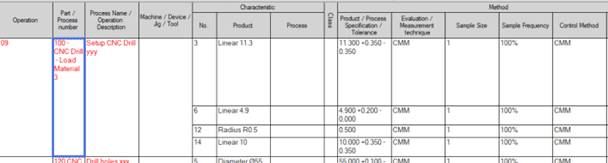
Figure 1: Control Plan in Datalyzer FMEA/CP
This field can contain a gage type or a specific gage. For example, if you want to measure with a caliper and you have 20 calipers in the plant it doesn’t make a lot of sense to pick a specific caliper. A caliper might be out for calibration, might not have passed its last calibration, etc. and then the operator needs to pick another gage.
In other cases, there is only one gage available in the plant capable of performing the measurement like a specific CMM. In that case the specific gage can be selected. When a gage is selected, you might want to verify if that gage is properly calibrated. If not, an action is required to perform calibration.
Whether a proper MSA study is performed it a bit more complicated because the MSA study either needs to be done for that specific product or for a representative product with similar characteristics and that gage type, not necessarily for the selected gage. Also, multiple studies can be performed with the gage (Bias, Linearity, GRR Type 1,2 and or 3 and stability). So, an engineer could evaluate the status of the MSA studies for that gage and add the information in the field.
During the FMEA/Control Plan process we might trigger a calibration or MSA study. But what happens the other way around?
Gage Management
When a specific gage fails calibration, we can run a report to see which control plans that specific gage is used. This is not so easy for a gage type but would be possible in case a specific gage is selected.
We know all the Control Plans where that gage is selected, and we can see which Control Plans require attention and could impact the FMEA.
If you have a specific gage for a measurement and that gage is failing calibration, then the detection in the FMEA is basically automatically a ‘10’. You cannot measure it so you cannot detect it.
This might require immediate action by a process engineer so we can email a report to the owner of the Control Plan when a gage calibration has failed. This way you have a closed loop between Gage Management and FMEA.
9%
Cost Reduction Achieved by customers


What customers say
“Datalyzer helped us automatically link quality data from all processes for advanced analysis”
Dave Beeren
Yield Engineer, Philips
Industries we serve

ISO Certified
ISO 27001 & SOC2