50+ countries
Global use, local impact

47 years in business
Originated in 1979

50+ employees
Europe, USA and Asia

2000+ customers
More than 20.000 users
Blog: Necessary changes in Statistical Process Control in Industry 4.0
Introduction
SPC is an essential method required in manufacturing. In several industries (automotive, aerospace semiconductor, medical devices, etc) it is mandatory that real time SPC is implemented. The power of SPC is that we compare what is happening in the process with the ideal situation and that we do this comparison in real time. If anything has changed (an out of control) we instantly respond and find the root cause and bring the process back in control. The operator plays an essential role in this out-of-control action process.
To establish what is normal we still use the statistical same rules which were used more than 100 years ago. In this blog we will explain why the standard rules will not work anymore in 2026 and why OEM’s, auditors, statistical trainers etc MUST change their thinking.
Nowadays issues with Statistical Process Control
There are two main problems in industries causing SPC to fail in modern manufacturing moving towards Industry 4.0:

1. Measurements are taken automatically
Over the last 10 years we have seen a lot of changes in industry on how measurements are taken. Towards Industry 4.0, we see more and more automatic equipment like camera’s, CMM’s, sensors and PLC’s etc taking measurements and automatically storing them into databases, MES systems and SPC systems etc.
In a lot of cases the operator is not even involved. If the operator is not involved anymore and we take measurements automatically then who will be responsible for looking for the cause of an out of control (OOC) and take the corrective action. If that responsibility is not assigned, then the system is not real time anymore and it will be a lot harder to find the root cause of a special cause of variation and even worse issues causing scrap or downtime will not be corrected anymore.
We can only make statements like last Tuesday we had 6% scrap and we saw that the process went out of control at 14:13 pm until the end of the batch. We don’t know the root cause and the problem was not corrected.
2. Much more measurements are taken
The increasing number of measurements in Industry 4.0 will give two big problems: Issues with the performance of the database and the Risk of False Alarms
Database Performance
First of all, the amount of measurements are normally not suitable to put in SPC. A historian can easily store 1 measurement per 5 seconds that would mean in SPC we would see 720 subgroups per hour. When you collect approx. 20 characteristics of a process which is not uncommon it would mean more than 14000 subgroups per hour for one process.
For each point a lot of statistics need to be calculated. Most SPC systems use a relational database like SQL server or Oracle and a relational database is not suitable to handle this amount of data and present them in a logical way to the operator. With each measurement we need to store date and time but also all related tracking and tracing information like shown in figure 1. This is information like batch nr, operator and shift etc. In some cases we also need to group the data like across cavities or across machine positions. Getting data from an automated data collection with a frequency of a few seconds makes it impossible to store these amounts of data.
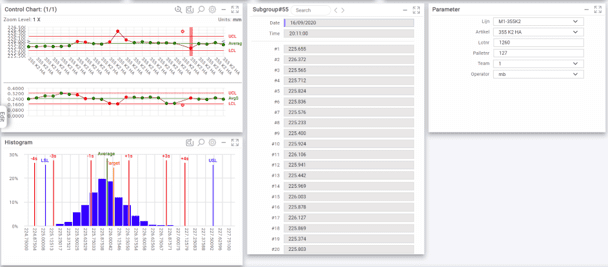
Figure 1: SPC information per subgroup
False alarms in SPC
The problem of false alarms is another big problem. In the 1920’s, when Walter Shewart established the method of SPC, he was looking for the correct limits to distinguish between common cause variation and special cause variation. If you set the limits to wide you will not get any false alarms but you will not detect special causes of variation in time. The selection of the control limits is a compromise between responding too often and looking for a cause which is not there and responding too late. At that time setting the control limits at 3 sigma was a perfect compromise. 0.27 % of the subgroups would fall outside control limits without an assignable cause (false alarm). We typically use 2 charts (average and range) so 0.54% of the subgroups will give a false alarm when we only look at control limits and ignore all other rules like runs, trends and zone rules. If we would take those into account it would be more than 2% false alarms (Wheeler, Advanced Topics in Statistical Process Control).
At that time people were performing SPC with pen and paper and typically were monitoring something like 4 quality characteristics with 1 subgroup per 30 minutes. If you ignore runs, trends and zone rules and only look at subgroups out of control limits the number of false alarms in such a situation would be 1 false alarm per day when we run 24 hours. An operator was fairly certain that an alarm was caused by a special cause of variation and he should look for the cause and record the cause and action in the subgroup.
In nowadays manufacturing aiming at Industry 4.0, we easily chart 50 characteristics (product or process) with 1 subgroup per 5 minutes. If the process would be perfectly in control it would mean we would get approx. 26 false alarms per shift of 8 hours or 1 false alarm each 20 minutes. 1 alarm per 20 minutes only occurs if the process is running in control without any special cause of variation, which is very rare and if we do not apply runs, trends and zone rules. If we would apply all these rules in the example above we will present 1 false alarm to the operator each 5 minutes if the process is running perfectly! Keep in mind that nobody knows how to distinguish between a false alarm and a real alarm.
If you will use automatic measurements with a high frequency you cannot use standard SPC rules anymore and present out of controls to the operator. An operator screen will then look like figure 2 and an operator doesn’t have time to work on that many out of controls at the same time.
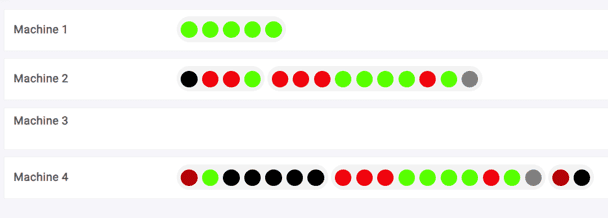
Figure 2: SPC Status Dashboard
Auditors, trainers and lean six sigma engineers need to clearly understand the above because otherwise SPC will always fail in these situations.
Automated Measurements and Automated SPC in 2026
Datalyzer has always been on the forefront of SPC software. In the web based Qualis 4.0 solution we solved all the problems above. In case of automated measurements if an out of control or out of spec situation occurs that situation is added to an OOC/OOS action screen. When the operator opens the SPC screen an indicator shows the number of subgroups requiring his attention and he can open the screen as shown in figure 3. Smart features assist the operator to quickly add notes to the out of controls.

Figure 3: Out of control/Out of spec action screen
Increase performance for automated data import
Datalyzer offers an automatic import service where we can import form any source. This import service has features to aggregate data. For example, the average and standard deviation for a specific time period can be calculated and stored in a subgroup without the need to store the individual measurements. So, the operator will see an average and range chart for a process period providing him with all the required information but the system still has a high performance because individual measurements are not stored. Even process capability measurements will be accurate with this improved method.
Reducing the Risk of False Alarms for large number of measurements
Let us be very clear. If a quality characteristic is critical and you cannot afford to produce bad products we recommend using 3 sigma limits. If that is not the case you have a few options:
Ad 1: Most processes are not 100% stable which means there is more variation between subgroups than within subgroups. In that case it is recommended to use the 3-way chart method.
Ad 2: We can fix the control limits. Normally after a startup period we know what the process is capable of and we can fix the limits at a level where we don’t get too many false alarms. We can even calculate how far we allow the process to deviate before we start taking action. This method is called Modified Control Limits and is for example used in processes with a changing average like grinding.
Ad 3: We can also set a Ppk benchmark for a process and ignore out of controls if the Ppk is still above the benchmark. The idea behind this method is that an out of control for a chart with a Ppk of 4 will be less priority than an out of control for a chart with a Ppk of 1.1. If a process with a high Ppk starts to drift the Ppk will automatically drop below the benchmark and will come priority. In Datalyzer Qualis this Ppk benchmark can be set differently per chart if needed.
Conclusion
Traditional SPC will not work in industries with highly automated measurements in a high frequency (Industry 4.0). A different approach is required and customers, auditors and all people involved in the process need to embrace this new method to keep getting the results from an SPC implementation.
9%
Cost Reduction Achieved by customers


What customers say
“Datalyzer helped us automatically link quality data from all processes for advanced analysis”
Dave Beeren
Yield Engineer, Philips
Industries we serve

ISO Certified
ISO 27001 & SOC2