50+ countries
Global use, local impact

47 years in business
Originated in 1979

50+ employees
Europe, USA and Asia

2000+ customers
More than 20.000 users
Efficient implementation of linkage between Design FMEA (DFMEA) and Process FMEA (PFMEA)
Introduction in FMEA
When creating any part or product, risk management is essential for delivering reliable, high-quality products. Two important tools used to identify and mitigate potential failures are Design Failure Mode and Effects Analysis (DFMEA) and Process Failure Mode and Effects Analysis (PFMEA). While they serve distinct purposes, DFMEA focusing on potential design-related issues and PFMEA targeting risks within the manufacturing process, their effectiveness is optimized when they are closely aligned.
Understanding the linkage between Desgin FMEA and Process FMEA is critical for creating a seamless transition from product design to production. This connection ensures that risks identified during the design phase are properly addressed during process planning, leading to a more robust product and efficient manufacturing process. In this blog, we’ll explore how DFMEA and PFMEA complement each other, how insights from one feed into the other, and why integrated risk management across these stages is key to operational excellence.
If you want to learn more about our Datalyzer FMEA software, and how this software can help you to efficiently implement the linkage between Design FMEA and Process FMEA, refer to this page.
Understanding Design FMEA (FMEA)
DFMEA is a proactive risk assessment tool used during the product design phase. Its primary goal is to anticipate potential failure modes in a product’s design before they reach the customer and ideally before the product even reaches production. By systematically evaluating how each component or function of a design might fail, DFMEA helps teams prioritize design improvements based on risk, ultimately leading to more robust and reliable products.
A DFMEA typically examines three main factors for each potential failure:
These three scores are multiplied to calculate a Risk Priority Number (RPN), which guides teams on which risks require urgent action
A Simple Example: The Office Chair
Let’s consider an example that’s easy to imagine: the design of a new ergonomic office chair. Suppose your company is designing a chair with adjustable armrests. In your DFMEA, you might identify the following potential failure mode:
An RPN of 210 would flag this failure mode as needing attention. The design team might respond by reinforcing the locking mechanism, switching to a more durable material, or introducing additional validation tests during the prototype phase. In the Datalyzer DFMEA format it would look like this:

Figure 1: Datalyzer DFMEA
It doesn’t matter if you’re working in automotive, healthcare, electronics, or consumer goods, the underlying logic is the same: DFMEA is about asking “what could go wrong?” before anything actually does and then designing it out.
Linking DFMEA to PFMEA: From Design Intent to Manufacturing Reality
Once the design phase identifies and addresses potential failure modes through DFMEA, the focus shifts to how the product will actually be made. This is where Process Failure Mode and Effects Analysis (PFMEA) comes in.
PFMEA takes the insights from DFMEA and evaluates the potential risks associated with the manufacturing and assembly processes. While DFMEA asks “What could fail in the design?”, PFMEA asks “How could we fail while building it?” The goal is to ensure that the manufacturing process can consistently produce parts that meet the design intent.
Continuing the Example: The Office Chair Armrest
Let’s revisit the adjustable armrest that showed a potential design risk due to a weak locking mechanism. After the design is finalized with a more robust locking component, the PFMEA team looks at how this new part will be assembled on the production line. The potential process-related failure mode might look something like the below:
Even though the design issue was resolved, the PFMEA reveals that the production process could reintroduce a similar failure if not properly controlled. To mitigate this, the team might introduce:
In the Datalyzer PFMEA form this would look like this:
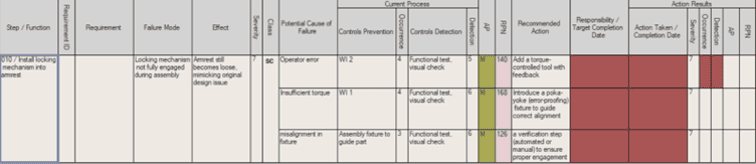
Figure 2: Datalyzer PFMEA
This example illustrates the crucial handoff from DFMEA to PFMEA. The design team improves the product, but the manufacturing team ensures that the process doesn’t reintroduce risk. When both analyses are aligned, organizations can catch more issues early, reduce costly rework, and protect the customer experience.
Mapping DFMEA to PFMEA: Column-by-Column Linkage
Although DFMEA and PFMEA serve different stages of product development, they share a common methodology. More importantly, certain outputs of the DFMEA become critical inputs to the PFMEA, ensuring design risks are addressed in manufacturing. Here’s how key DFMEA columns influence the structure and content of the PFMEA:

Bridging the Gap: Why This Mapping Matters
Understanding this flow helps cross-functional teams—engineering, quality, and manufacturing—speak the same language and track risks across the product lifecycle. Without this connection, there’s a danger of losing critical insights during the transition from design to production, potentially leading to repeat issues, warranty claims, or safety risks. A well-integrated DFMEA-to-PFMEA process doesn’t just reduce risk, it fosters collaboration, increases efficiency, and strengthens overall product quality.
Design FMEA and Process FMEA are not meant to be islands. When these tools are connected thoughtfully, they create a powerful feedback loop between product design and manufacturing, significantly reducing the risk of failure, improving quality, and boosting customer satisfaction. As we’ve explored, DFMEA identifies what could go wrong in a product’s design, while PFMEA focuses on how the process of building that product might fail. The most effective organizations treat them as part of a continuous risk management process, not separate checkboxes.
Actionable Tips for Better Integration
- Establish a Cross-Functional Team Early
Involve design, manufacturing, quality, and supplier representatives in DFMEA discussions so process realities are already considered when risks are first identified. - Use a Common Template or Software Tool
Ensure that DFMEA and PFMEA use consistent terminology, risk criteria, and version control. Integrated FMEA platforms can help maintain traceability between related failure modes. - Carry Over Critical Risks from DFMEA to PFMEA
Don’t treat PFMEA as a fresh start. Use the DFMEA output, especially high-severity risks, as a starting point to evaluate how process failures might reintroduce those risks. - Map Functions to Process Steps
Create a traceable link between what the product must do (DFMEA) and how each process step ensures that function is achieved (PFMEA). This ensures nothing gets lost in the handoff. - Review Both Together During Design Reviews and Process Sign-offs
Make DFMEA and PFMEA review a joint checkpoint. This helps detect gaps and verify that risks addressed in design are not reintroduced by the process. - Update FMEAs Together Over Time
As changes occur—whether in design or production—update both documents accordingly. Keeping them aligned ensures continuity of risk control throughout the product lifecycle.
Final Remark
In this blog we hope we have provided you more details of both Design FMEA and Process FMEA and how to implement the linkage between them efficiently. By integrating DFMEA and PFMEA intentionally and early, teams can bridge the gap between engineering and operations, reduce the cost of quality issues, and ultimately deliver better, more reliable products to market. Feel free to reach out in case of additions or further questions.
9%
Cost Reduction Achieved by customers

What customers say
“Datalyzer helped us automatically link quality data from all processes for advanced analysis”
Dave Beeren
Yield Engineer, Philips
Industries we serve

ISO Certified
ISO 27001 & SOC2