50+ countries
Global use, local impact

47 years in business
Originated in 1979

50+ employees
Europe, USA and Asia

2000+ customers
More than 20.000 users
Blog: The Normal Distribution Myth and Statistical Process Control
Introduction
Not all data are normally distributed. There are many different possible distributions. It’s a common belief in the world of quality engineering that if data isn’t normally distributed, you can’t apply control charts because normality is a requirement to apply control charts. Turns out, this belief doesn’t hold up – and in this blog we will explain why.
What is the Normal Distribution Curve?
A normal distribution – also known as a bell curve, Gaussian distribution, or Gauss distribution – is a continuous probability distribution that is bell-shaped and symmetric around the mean. It is the most widely used probability distribution in statistics.
In a normal distribution, approximately 68.27% of the data falls within one standard deviation of the mean, 95.45% of the data falls within two standard deviations, and 99.73% of the data falls within three standard deviations.
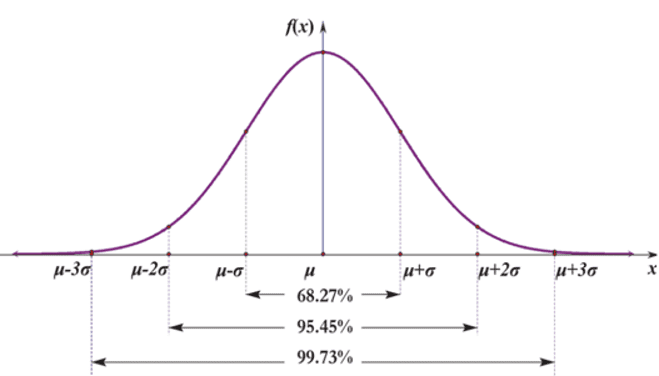
Normal Distribution in Statistical Process Control
The usage of the normal distribution has roots going back nearly a century. When Statistical Process Control was first introduced in the 1920s by Walter Shewhart, many of the tools we still use today, like X̄ and R charts, were built on assumptions tied to the normal (Gaussian) distribution.
A statistic often used in quality control is the average of multiple samples. A known concept in probability theory is the Central Limit Theorem. The Central Limit Theorem states that the sampling distribution of the averages approaches a normal distribution as the size of the sample increases, regardless of the shape of the original population distribution. The central limit theorem was first established in a specific case by Abraham de Moivre in 1733, and then generalized and proven in a more general form by Pierre-Simon Laplace in 1810, who is often credited with its overall discovery and demonstration of its importance in probability theory.
Shewhart used this theorem and established that placing control limits at three standard deviations from the process mean — in both directions — offered a practical balance between the risk of reacting to a false alarm and the risk of not reacting to a true signal. (Economic Control of Quality of Manufactured Product, 1931)
SPC uses Control Charts to monitor data points and identify when a process deviates from its expected normal behavior, indicating potential issues. When a statistic does follow a normal distribution, about 99.7% of data points are expected to fall within three standard deviations of the mean. When a measurement is found outside the 3 sigma limits we assume there is a special cause of variation. That means there’s only a 0.3% chance (or 1 in 370) of a measurement value beyond 3 standard deviations and there is not a special cause of variation.
Although the central limit theorem is applicable, it is not a requirement for using control charts. There are areas in statistics where normality is required. For example in applying Hypothesis Testing, specific tests require normality. For example the F- and t-test require data to be normally distributed.
Also, for capability reporting 99.7 % of the variation is included in the calculation. If data is not normally distributed slight deviations can occur if you assume the data is normally distributed. In case of heavy tails in the distribution it is advised to report the non-normal capability calculation.
Somehow over the years this normality requirement in Hypothesis Testing and Capability resulted in the misconception that normality is required for applying SPC and the use of Control Charts.
So why is normality not required?
The Three-Sigma Rule Works (Even for Non-Normal Data)
If normality were truly required, range charts wouldn’t work because they are never normally distributed— yet they’ve been used for decades and continue to be highly effective.
While statistical tests like the t-test and F-test do require a normal distribution, SPC on the shop floor is not about hypothesis testing. It’s about answering a more practical question: Is my process stable or not? And the good news is, SPC can still give you valuable insights even when your data isn’t normally distributed.
Experts like Donald Wheeler (Advanced Topics in Statistical Process Control) have shown for decades that it is a myth that Control Charts work because of the Central Limit Theorem. SPC is built to handle real-world scenarios. In fact, Wheeler’s findings – supported by earlier work from Irving Burr, who analyzed 27 different non-normal distributions – demonstrate that Control Charts remain reliable even with data that show extreme skewness (over 1.9) or kurtosis (above 12) because in every distribution more than 99% of the measurements lay between the 3 sigma limits. The core principle still holds: when using three-sigma limits, the chance of a false alarm (a point falling outside the limits due to common cause variation) remains low – less than 1% – regardless of the underlying distribution. That’s good news for those of us who don’t live in textbook conditions.
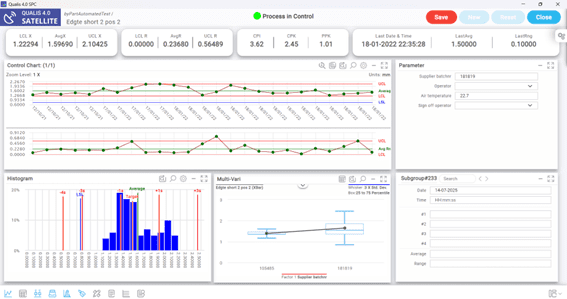
Working with Non-Normal Data: Practical Tips That Work
In Hypothesis Testing, it’s recommended to transform data so it meets the assumption of normality. If your goal is to use Control Charts to monitor process stability, transforming your data can do more harm than good. Operators may struggle to understand the variation in transformed values, and as a result, the Control Charts can lose practical meaning. Unless you’re performing formal statistical tests, we strongly recommend keeping the data in its original form.
In most of the cases you don’t need to transform your data or look for a perfect distribution match. Here’s how to handle non-normality in practice:

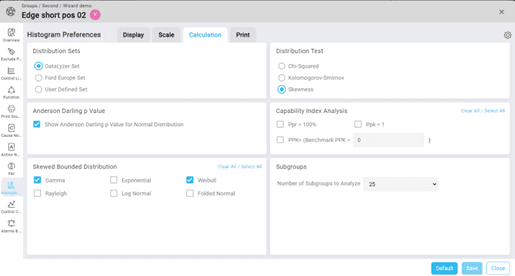
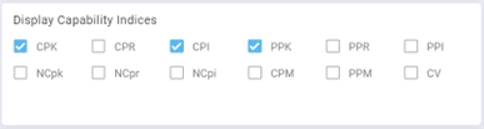
In Qualis SPC 4.0, you can use the “skewed bounded distributions” and NCpk options to use the specific distribution models to be used to determine the best fit curve and calculate the non normal capability.
Conclusion: Focus on Process Signals, Not Distributions
All that being said and demonstrated, we can be sure that we don’t need the data to follow a normal distribution to keep your process in control. Donald Wheeler’s insights show that effective SPC is about understanding process behavior. By shifting focus from strict assumptions to special causes of variation recognition, you get:
Instead of worrying about normality, invest your energy in:
As Dr. Wheeler puts it: “The shape of the histogram doesn’t determine your process control, your signals do.”
By adopting Wheeler’s principles, you gain a more practical, intuitive way to keep processes stable and improve continuously.
So if your data isn’t textbook-perfect? Don’t worry. Control Charts weren’t made for textbooks, they were made for the shop floor. And that’s why it works..
9%
Cost Reduction Achieved by customers


What customers say
“Datalyzer helped us automatically link quality data from all processes for advanced analysis”
Dave Beeren
Yield Engineer, Philips
Industries we serve

ISO Certified
ISO 27001 & SOC2